
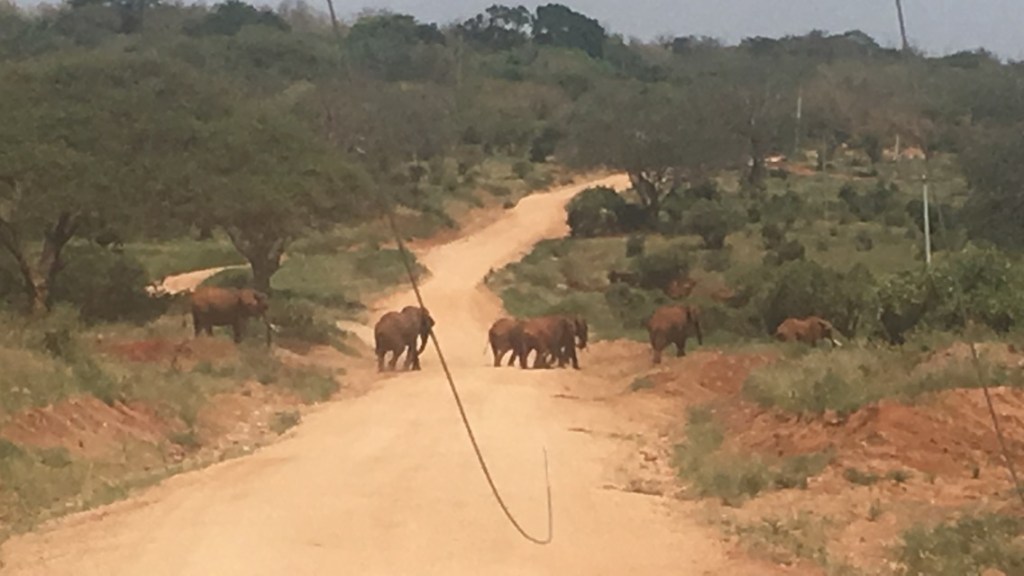
And so it was. A family of elephants, small only in number, rolled across the view stretching out before me, a fine red mist trailing in their wake as they methodically progressed on their unrelenting journey from mysterious places to destinations unknown. Transfixed, I stood on the border of Tsavo East National Park, barely noticing the fading buzz of a tuk-tuk, the driver of which had refused to carry me further than where I now stood. He had muttered something about a regulation prohibiting his vehicle from entering the national park, his concern for which was puzzling considering his uniquely chaotic driving style. Either way, I was quite stranded, and between the potentially lurking pride of lions and myself, I considered myself to be in a rather vulnerable way. Fortunately, whatever was crouched waiting to pounce had suddenly reconsidered – probably a case of a big breakfast – and spared me to write for you!
A Kenya Wildlife Service (KWS) employee reports for a day’s work. The commute through town – a left, a right. Bloody potholes, bloody council! “Same old!”, he mutters. As the rising morning sun reflects off his rear-view mirror, he squints. Are his dazzled eyes mistaking him? Who is this standing on the side of the road, desparately waving him down? It was me, I was waving. Thank goodness for this man. Had it not been for his kind taking to hitchhikers, I might still be standing there to this day, wondering which rock my four-legged furry killer might spring from.
In I hopped and along we rattled to the Tsavo East KWS HQ – proper. On arrival, it was clear that this was a strange and special place. A short walk up from the ivory store was the main body of the complex. The grassy courtyard surrounded on two sides with single story off-white offices which neatly contained all the most powerful people in the national park. These camo-clad, high-ranking officials pondered and instigated the goings on in Tsavo. It was all very militarised. A far-flung reality from what I would later discover the UK’s conservation scene to resemble. These Kenyan sergeants, generals and wardens were a stark contrast to the quiet and quirky Berghaus-donning bourgeois volunteers, who were either retirees or had taken their Duke of Edinburgh awards to the next level.
With no room for Quechua and Karrimor, KWS make use of handguns and M4s. The stakes are high, higher than they are here in the UK. With vast swathes of land, and eye-watering profit to be made from exploiting the wildlife residing within, every step must be taken to ensure the government has the upper hand. A logistical lapse, a strategical slip might well pose a threat to human life. Rangers operating in the remote depths of the national park could be exposed to poachers who would take their lives as readily as they would that of an elephant or a rhino.
As may be obvious by now, this arena is something of a warzone. With their substantial budget, many operatives and motivated agenda, KWS are clear favourites. But, with huge areas of land to cover and opposition springing from unlikely places, the job of maintaining healthy ecosystems, while appeasing local people and tourists is by no means an easy one.
A healthy allowance does of course help. Last year, KWS was funded by various income streams, including charities, government contracts and visitor entrance fees; but mostly via undisclosed sources. The budget of over 2bn Kenyan shillings (KSh), equating to about £13.37 million, covers everything from advertising and seminars to animal feed and ammunition; not to mention staff tea, which cost the organisation a cool (or hot, depending on how you like yours) KSh5.1 million. To justify such expenditure, capital must be gained as a result. Whilst I am sure the average ranger would not turn up their nose at an elephant or brush off a buffalo, they do not work solely to conserve nature for their own enjoyment as the other incentives to protect their wildlife transcend that of personal affinity to it.
Kenya has a booming tourist industry, with many holidaymakers seeking to enjoy the wonders of the many national parks the country has to offer. KSh208 billion was generated from tourism in the 2022 post-covid bounce-back year, with this number expected to rise to KSh540 billion by 2027. This staggering projection means 1 out of every 20 Kenyan shillings making up the country’s GDP would exist, in part, because of the successful maintenance of its national parks for tourists to enjoy. This proportion of the economy must be protected and the financial commitment to its security appears to be a profitable one. Happy days? Not entirely.
Tsavo East is best known and loved for its booming population of elephants. They are undoubtedly a largely contributing factor drawing people in their droves and holiday spending money in its billions. What may resemble a perfect situation is not entirely as it seems. You would be forgiven for assuming that the only residents abiding within the national park’s boundaries are solely of a faunal disposition, but people live there too. Some inhabitants hold ancient ancestral claims to land upon which they have, in living memory, always resided on. Others have relocated to the parks, having found it more manageable than living in the pricier surrounding towns. It makes for quite a cocktail of conflicting interests. To break it down, here is a simple recipe:
Step One: Add about 15,000 ever-hungry elephants and grant them protected status.
Step Two: Add substantial human population to the national park who live a semi-subsistence lifestyle and depend massively on the nutrient-rich crops they grow.
Step Three: Stir in the migratory routes that were prepared long before any of us knew what an elephant was and ensure people’s farms fall within them.
Step Four: Let the mixture rest and see what happens. As can be expected, the resulting product turns out to be a very tricky situation indeed.
Those living in the national park have faced the ongoing issue of elephants running riot on their property. Stealing crops and trampling those that they do not eat, they quickly render an entire year of work useless for the people who would have poured time, effort and money into trying to feed their families. People are left in an impossible position without food, and without the means to trade and obtain an income. The desperate circumstances have led to an ugly conflict between people and the two parties. People have employed various grizzly retaliatory methods in light of the damage being caused on their land. This tactic has not been massively effective in curbing the issue of elephant raids and it has landed a few farmers in some legal trouble, courtesy of the protected status afforded to elephants.
Although the lives of elephants are important and should be protected, those of people should receive priority. This is why it is not enough to simply slap protected status onto elephants and hope for the best. The contingency plan must also consider the livelihoods and futures of humans living in national parks. Devising such a mediatory solution is no mean feat, but the Kenyan government gave it a crack. Financial compensation was promised to those who made eligible claims. To qualify for a pay-out, proof must be shown of elephant-inflicted damage to property or crops. Claims are assessed by a small team of camo-clad men with military stripes. The Sergeant of Tsavo and his small unit could boast of skills ranging from counselor to economist, with a proficiency in elephant shooing. These skills are put to the test several times each day – the latter I must admit to having partaken in. The energy and dynamism of these men is admirable and there are few who, for years, could put themselves up to the task of recording the damage to land and the subsequent destitution of the people living upon it.
The Sergeant is the keeper of an enormous leather-bound logbook brimming with thousands of orderly notes behind which families stand among broken homes and trampled prospects. Millions of shillings-worth of hopeful claimants, who would have seen the neat jottings of the Sergeant as a lifeline, hopeful they would remain – at the time of my visit at least. The Sergeant and his unit were not exactly strange faces in the community. In the week I spent with them, it was clear that the locals were all too familiar with their presence and all to used to their promises. Even though some of the farmers spoke with a tone of annoyance verging on anger, it was clear that from the encounters I saw, the Sergeant had total control of all situations he found himself in. He had an air of aloof sincerity, which quelled some while exasperating others further – in any case, whatever he decided to say, it went.
The bestowing of such authority comes with the expectation of its responsible wielding. That is, the sensitive handling of and measured response to claimants exercising their right to access a vital lifeline. Fulfilment of these expectations by those carrying them out would be a deserved service to the many facing the plight they have been. Incredibly, there exists anecdotal evidence of unabashed roving enforcers, acting to protect their government’s interests in the face of their shortcomings as opposed to protecting those on the other side of the power scale. This allegation was placed by a stranger who, upon hearing of my days with the unit, told me of his friend who had been at the receiving end of some heavy-handed treatment courtesy of some KWS officials in an unconfirmed location.
This tiny window into the apparent behaviour of a government agency, albeit tipsily opened, points to some unassumed tactics. But with boots on the ground and military prefixes to their names, those working as members of the many units patrolling the human communities of the national parks could very much be forgiven for acting in a way they see fit to check the requirements for the gig. A sense of authority can be assumed from the donning of a uniform. With this, certain characteristics are internalised and behaviours, sometimes unfitting to a situation at hand, can emanate from their wearer. The badges, the patrols and the camouflage all act as drivers of the perceived expectations of the institution issuing them. It can also offer a guise under which some might relish operating with a diminished sense of autonomy and inversely proportionate authoritative powers.
Elsewhere in Kenya, shows of force do not only come as a result of galvanisation under a common profession, but also by a shared cultural heritage. Tensions have arisen elsewhere and this time, elephants are not involved. An ancient rite of passage falling into conflict with the laws of today have complicated the lives of the three involved parties. The practice in question is one involving the ritualised killing of lions, a species protected under Kenyan law. While this practice far outdates the centralised Kenyan government, circumstances are such that the younger body of power holds authority to prosecute those affiliated with a much older ruling entity.
Practically all offenders have faced some form of prosecution. However, of those apprehended, not one has suffered subsequent legal consequences of any magnitude, with cases dropped in almost all instances. Why? A judicial system holding legislative power in name only. When up against tribal leaders, whose immense social powers allow them to disgrace the names of those overseeing the legal processes against law breakers, cases seem to evaporate with minor, if any, repercussions. Not all species are so lucky to be afforded the luxury of ‘protected status’. It is commonplace for an aardvark or antelope to feature on the menu for many bushmeat-reliant Kenyans who, out of convenience or necessity, have been branded ‘major culprits’ in the 30-year 50% decrease in Kenya’s wildlife abundance.
Heels on both sides are firmly dug in and the camps don’t seem to be budging. Each is empowered by the perceived brazenness of the other, while contrasting consciences provide a steadfast and shared moral high ground. As with this face-off’s unchanging nature, so too does the logical conundrum endure: to preserve a traditional and valued practice, or to protect fast-disappearing Kenyan wildlife, a bastion of its heritage. It’s a strange paradox. The former cannot exist without the latter which it seeks to destroy. Yet, in a kind of antiquated stubborn dynamic, the struggle goes on. It is difficult to gage who the winners are. Not the animals, that much should be obvious. Not the rangers and judicial workers, who are made to prosecute their fellow citizens, albeit in vain, for carrying out long-held tribal rites. That leaves those carrying out the killings. With the continued fall of populations projected, communities will no longer have access to the natural resources needed to continue behaving in the way that they are.
Having said this, it is easy for us to point and tell others what to do. The idea of humans against nature – the eternal struggle against an environment out to get us! – might strike some as silly in its datedness. ‘Surely not!’, you might laugh, while reclining on a sofa in a high-ceilinged living room to rest your weary legs after your long walk from the bus stop having frequented your favourite brunch spot that does your poached eggs just right. Phew! Life is very different for those who are at odds with the place they call home. They live without the luxuries we so flippantly deem staples. The least we can do is hope for some kind of resolution that satisfies the needs of people and the nature within which they live.
The good news is that such a resolution seems to have been reached in the arena shared by people and marauding elephants. With their best efforts in providing compensation proving ineffective, the Kenyan Ministry for Tourism and Wildlife have turned to a private insurance firm to clean up. The scheme is breeding some excitement. The days of waiting years for a pay-out could finally be over. By paying a small premium, small holders are protected from financial ruin. Some can even opt in for free. While the cash does alleviate some of the trauma involved with an elephant raid, it is a reactive approach and does not stop the ranging megafauna running their course. There is not a lot that can be done to stop a hungry herd from eating their fill. A rather genius solution has been devised to deter the herds…hives. The common trope concerning elephants and mice seems to extend to other small things. Situated in the perimeter fences of crops, the territorial insects provide both a level of protection and a means of income to farmers, who can reap the rewards of their crop and honey harvest. Un-bee-lievabe! While the funding and deterrence solutions are not blanket fixes, they offer some reprieve to both sides of this particular human-wildlife conflict. People are protected against elephants and elephants are deflected before they can antagonise people to the point of prompting dangerous retribution.
Not for the first time, it should be said, has the Kenyan government drafted in a third-party entity to aid in the fulfilment of the requirements for statehood. While some may wonder what took them so long to seek help, all’s well that ends well. People needed money and the government stepped in, or rather stepped out, to allow the private sector to help its citizens. True, an opportunity has been missed to score some points in the public opinion polls; but the issue has been patched by a magnanimous organisation.
There are more cases of the outsourcing of services. Essential infrastructure has long been left to China who, in their global initiative dubbed the ‘new silk road’, have a vast stake in the infrastructure of the country.
 The Natural Investigation
Leave a comment